
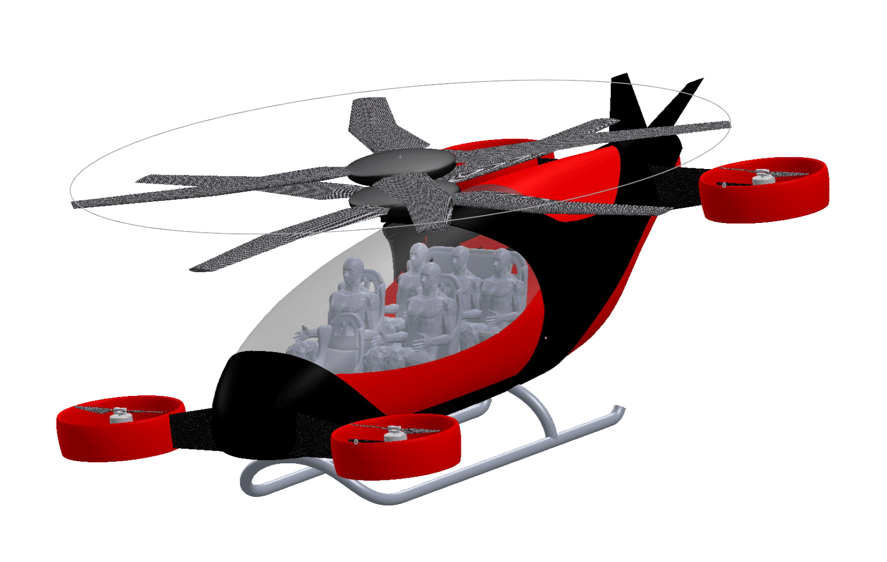
LeviationTech is an innovative eVTOL rotorcraft opted featuring the highest disk-weight ratio for maximum lift, frame structural supporting interchangeable cabins for instant mission reconfigurations. It opens new frontier of UAM with an array of Second Comer Advantages, optimized for economic ownership, and simple to operate, the highest cost-performance ratio.
Applications
- Type Series with payloads equivalent to 2, 4 & 6 passengers (model 2S, 4S and 6S respectively) .
- Platform technologies, design & production system and supply chain.
- System Engineering enables design-to-product pipeline, volume production and cost reduction of series.
- Modular Options for utility, cargo, passenger, stretcher deliveries, even in smallest type.
- Last-mile logistic cargo delivery market.
- Public Service Market, fire-fighting, medical transport, emergency response & public safety.
- Urban Air Mobility (UAM) air taxi and personal transport market, extended to inter-city, rural and field applications.
LeviationTech eVTOL Rotorcraft Roadmap
| Phase | Powertrain | Description | Signature Feature | Phase Delivery |
| Model Test | Battery Module Added Battery Module Generator Module | Simulation, Scale-down proof and Feasibility Study | 1:4 Model Experiments | already achieved |
| Prototyping | Battery Module Added Battery Module Generator Module | NASA Work Group 2 (intra city delivery & taxi) 2-seater | Test Fly | 1st year |
| Certification | Battery Module Added Battery Module Generator Module | Progressive from Unmanned Delivery to Passenger Carriers | With 4 times longer range | 2nd year |
| Production | Battery Module Added Battery Module Generator Module | Product to Market, pipelined rollout of Model 2S, 4S and 6S | Higher safety qualification | 4th year |
Specs
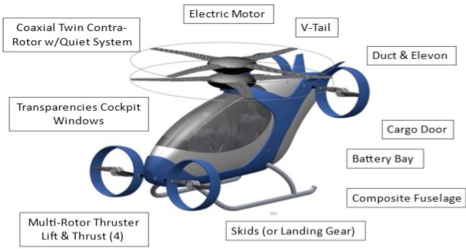
- Advantage: compound rotorcraft, maximum lift power – weight ratio outstanding among NASA UAM Work Group 2 & 3.
- Power Plant: electric drive simplicity, reliability and high-torque.
- Active Controls: ducted fan efficiency with added ground safety.
- System Engineering: future-proof and forward-compatible modular architecture –east for power upgrade and cabin reconfiguration.
- Framed Structure: with flexibility of cargo/passenger options.
- Stretcher Carrier: featured autonomous EMS transportation.
- Flight control: unmanned optional pilot apt mission tasks.
- Progressive autonomous – from remote control to AI-enhanced.
- Redundant control fly-on-wire and power-on-wire for reliability.
- Full-composite, European race-car crash-proof and fire safety.
- Full-electric or Hybrid power modules are available.
- Small dimension can fit into shipping containers in transportation.
- Cost effectivity + safety with modest price of $250K.
Unique Functional Features
Design-to-Product Resources
Inventor: the Chief Designer, president and co-founder of LeviationTech (since 2021). For many years he established his own aircraft design and consulting business. Was VP of Diamond Aircraft, chief designer for D-Jet (London, ON, Canada) and Sino Swearingen Aircraft VP Engineering of SJ-30 (San Antonio, TX, USA. Before he worked in development groups for Fairchild Aircraft and Mooney Aircraft. Since 2018, headed Work Group 4 of NASA Transformative Fly initiative. The team is familiar with all issues about eVTOL and UAM technologies, marketing and business. He received M.S. in Aerospace Engineering from Univ. of Colorado.
Facility: The designated location is a general aviation airfield in the rural center of Texas Triangle, where the team, partners and supply chain have been all around, ready.
Business: LeviationTech was established in US in 2022. Its eVTOL rotorcraft design concept was advised by Martin Stucki of Marenco Aviation in Switzerland. LeviationTech specializes aerodynamics for practical matters (payload and costs). Its US and international development is headed by Jin Luo, who consulted Martin Stucki’s Marenco Swisshelicopter AG’s international development in 2010-2016, including an Asian location development.
Progress: Through past 3 years, LeviationTech finished the concept design and feasibility study. It pressed hard to keep with NASA Transformative’s initial concepts and model, built a scale-down (1:4) model for test and proof, filed and granted the key patent.